
Eye Health Guide · ORINvue
Hyperopia (Long-sightedness)
Hindi / common name: Hyperopia (paas ka dhundhla dikhna / doordrishti dosh)
Hyperopia, also called hypermetropia or long-sightedness, is a refractive error in which the eye has to work extra hard to focus, especially on near objects. Mild hyperopia is common in young children and often causes no problem because young eyes can focus strongly. As the focusing power falls with age, or if the hyperopia is higher, near work becomes tiring and both near and distance vision may blur.
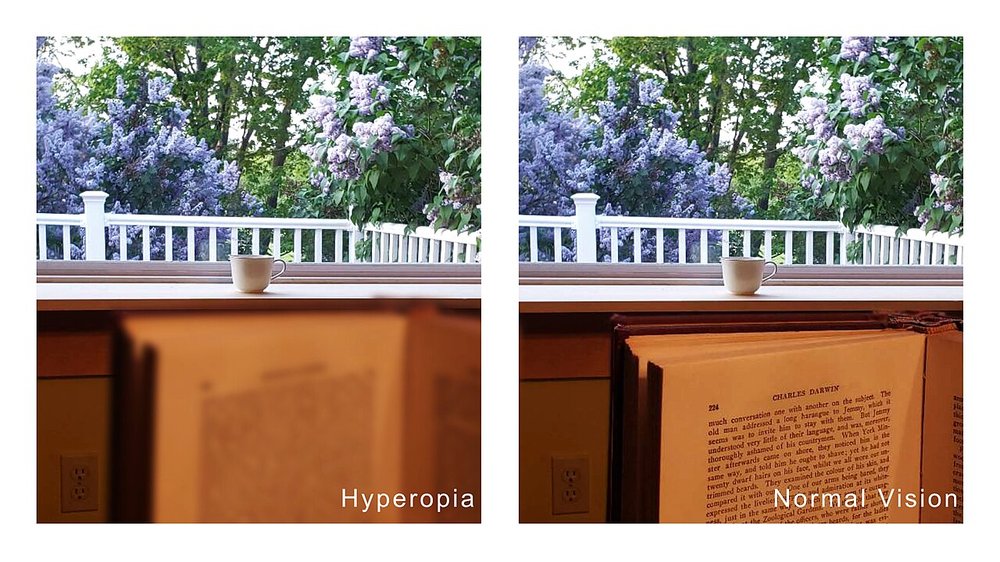

Symptoms of hyperopia
- Blurred vision for reading, phones or close work
- Eye strain, tired eyes or a pulling feeling after reading
- Headaches, often around the forehead, after study or screen work
- Difficulty concentrating on homework in children
- An inward-turning eye (squint) in some children with high hyperopia
- Needing reading glasses earlier than friends of the same age
Causes and risk factors
- The eyeball is slightly shorter than normal, or the cornea is flatter, so light focuses behind the retina
- It often runs in families
- Most babies are born a little hyperopic, and this usually reduces as the eye grows
- With age, the eye's lens loses its ability to compensate, so hidden hyperopia shows up in the late 30s and 40s
How it is diagnosed
Hyperopia can be missed by a simple 'read the chart' test because young eyes compensate by focusing harder. An optometrist measures it with refraction, and in children an eye doctor may use cycloplegic drops to relax focusing and reveal the full plus power. A binocular vision check helps find any associated squint or focusing problem.
Treatment options
- Spectacles with convex (plus) lenses, worn full-time or only for near work depending on the power and age
- Contact lenses for suitable adults
- Refractive surgery in selected adults, decided by an ophthalmologist
- For children with a squint caused by hyperopia, full-time glasses prescribed by an eye doctor are often the main treatment
Glasses and lens options
Plus lenses are thicker in the centre. For higher powers, a smaller frame and a high-index or aspheric lens keep glasses lighter and thinner. Children should wear polycarbonate lenses in a flexible, well-fitting frame. Adults over 40 with hyperopia often benefit from progressive lenses that cover distance, computer and reading in one pair.
Prevention and everyday care
- Hyperopia itself cannot be prevented, but its effects can be managed
- Get a child's first full eye check before starting school
- Do not ignore frequent headaches or reluctance to read in children
- Take regular breaks during long reading or screen sessions
When to see an eye specialist the same day
- Sudden severe eye pain with redness, halos around lights, headache or vomiting (possible acute angle-closure glaucoma, which is more common in hyperopic eyes)
- An eye that suddenly turns in or out
- Sudden loss of vision
Hyperopia in Lucknow
In Lucknow many school children are first noticed with vision problems through school screening or coaching-class strain. Hyperopia can hide behind 'he just doesn't like reading', so a proper test is worth it.
How ORINvue can help
At ORINvue, every eye test is done by our qualified optometrist, Khushboo Gangwar, who checks both distance and near vision so hidden hyperopia is not missed; the test is free with every spectacle package. We make plus-power glasses, including thin lenses and kids' polycarbonate lenses, with spectacles from ₹999 all-inclusive. If a child needs a dilated (cycloplegic) examination or squint care, she guides you to a trusted eye specialist.
Book Free Eye TestFrequently asked questions about Hyperopia
Is hyperopia the same as presbyopia?
No. Hyperopia is caused by the shape of the eye and can be present from birth. Presbyopia is the age-related loss of near focusing that affects everyone after about 40. You can have both.
Do children grow out of hyperopia?
Mild hyperopia often reduces as the eye grows. Higher hyperopia, or hyperopia with a squint or lazy eye, usually needs glasses and regular follow-up.
Can hyperopia cause headaches?
Yes. The constant extra focusing effort can cause eye strain and headaches, especially after reading or screen work. Correct glasses usually relieve this.
Do I need to wear plus glasses all the time?
It depends on your power and age. Some people need them only for reading, others full-time. Your optometrist or eye doctor will advise based on your test.
Is hyperopia linked to glaucoma?
People with significant hyperopia have shallower eyes and a higher risk of angle-closure glaucoma. Regular eye checks after 40 are important.
Explore more: Eye Health Guide (all conditions) · Optical & spectacles questions answered · ORINvue blog
Book a free eye test at ORINvue
Every eye test is done by our qualified optometrist, Khushboo Gangwar, free with every spectacle package. Opening December 2026 in Kalyanpur, Vikas Nagar, Lucknow. Open daily 10 AM–10 PM.
Book Free Eye Test