
Eye Health Guide · ORINvue
Myopia (Short-sightedness)
Hindi / common name: Myopia (nazar kamzor / door ka dhundhla dikhna)
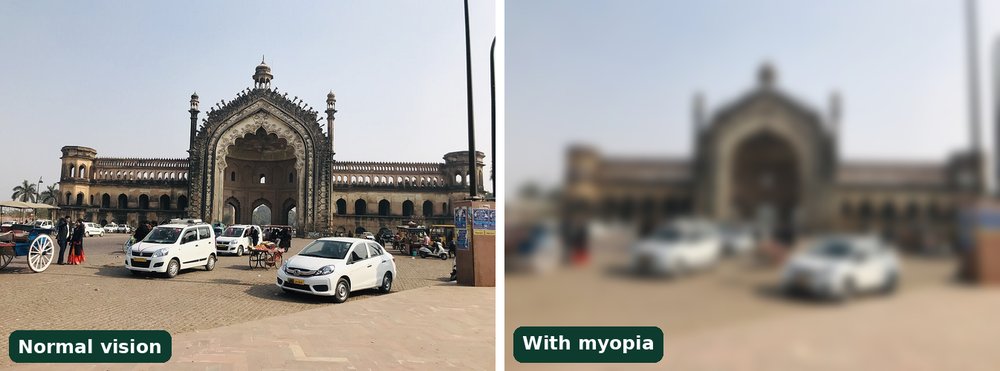
Myopia, or short-sightedness, means you can see near things clearly but distant things look blurred. It is the most common reason people in India start wearing spectacles, and it is rising fast among school and college students who spend long hours on books and screens. The good news: myopia is easy to correct with the right glasses or contact lenses, and in children its progression can often be slowed.

Symptoms of myopia
- Blurred vision for distant objects such as the classroom board, road signs or TV
- Squinting or half-closing the eyes to see far
- Holding phones and books very close
- Headaches or eye strain after driving, lectures or sports
- Difficulty seeing clearly at night, especially while driving
- In children: sitting close to the TV, poor board work or complaints at school
Causes and risk factors
- The eyeball is slightly too long, or the cornea is too steeply curved, so light focuses in front of the retina instead of on it
- Family history: children with one or both myopic parents are at higher risk
- Long hours of near work (study, phones, tablets) and little time outdoors in daylight
- Early onset in childhood, which usually means faster progression through the school years
How it is diagnosed
Myopia is found during a routine eye test. An auto-refractor gives a starting estimate, and an optometrist then confirms the exact minus power (for example −1.25 D) with subjective refraction using a trial lens set. For young children, an eye doctor may use cycloplegic drops that relax focusing so the true power is measured. People with high myopia (around −6.00 D or more) should also have a dilated retina check by an ophthalmologist, because a longer eyeball has a higher risk of retinal problems.
Treatment options
- Spectacles with concave (minus) lenses: the simplest and safest correction
- Contact lenses (soft or rigid) for sports, work or appearance, after proper fitting and hygiene advice
- Refractive surgery (LASIK, SMILE, PRK) for suitable adults whose power has been stable, decided by an ophthalmologist
- Myopia control for children: specially designed myopia-control spectacle lenses, low-dose atropine eye drops (prescribed by an eye doctor only), or orthokeratology lenses
Glasses and lens options
For low to moderate power, standard 1.56 index anti-glare lenses work well. For higher minus powers, thinner high-index lenses (1.60, 1.67) reduce edge thickness and the 'bottle glass' look. Children need impact-resistant polycarbonate or Trivex lenses. A smaller, well-fitted frame keeps thick edges in check. If you spend long hours on screens, an anti-glare coating helps with reflections.
Prevention and everyday care
- Get children outdoors in daylight for about two hours a day where possible
- Follow the 20-20-20 rule: every 20 minutes, look 20 feet away for 20 seconds
- Keep books and screens at a comfortable distance (about an arm's length for laptops)
- Study in good light and take regular breaks during long coaching or homework sessions
- Check children's eyes every 6 to 12 months, or as advised
When to see an eye specialist the same day
- A sudden shower of new floaters or flashes of light
- A dark shadow or curtain moving across your vision
- Sudden drop in vision in one eye
- Eye pain with redness and blurred vision
Myopia in Lucknow
Lucknow has a large student population, from school children to coaching students in areas like Aliganj, who spend many hours reading and on screens. That makes regular eye tests and outdoor breaks especially important for families in the city.
How ORINvue can help
Every eye test at ORINvue is done by our qualified optometrist, Khushboo Gangwar, a complete vision and eye-health check in 10–15 minutes that measures your exact myopia power, free with every spectacle package. Spectacles start from ₹999 all-inclusive with no hidden lens charges, and most single-vision glasses are ready in 24 hours. For children with fast-rising power or anyone with high myopia, she guides you to a trusted eye specialist for a detailed retina check and myopia-control treatment.
Book Free Eye TestFrequently asked questions about Myopia
Can myopia be cured permanently?
Spectacles and contact lenses correct myopia but do not cure it. Refractive surgery can reduce or remove the need for glasses in suitable adults, but the eye's structure stays the same, so regular check-ups are still needed.
Does wearing glasses increase my power?
No. Glasses do not make myopia worse. Power usually rises in children because the eye is still growing. Wearing the correct power helps you see comfortably; wearing the wrong or no glasses causes strain.
At what age does myopia stop increasing?
For many people power stabilises in the early to mid twenties, but it varies. Long hours of near work can keep it changing, which is why yearly eye tests are recommended.
Is −6 power dangerous?
High myopia is not dangerous on its own, but it carries a higher risk of retinal detachment, glaucoma and macular problems. A yearly dilated eye examination by an ophthalmologist is sensible.
Can myopia be slowed down in children?
Yes. Outdoor time, screen breaks, myopia-control spectacle lenses, low-dose atropine drops prescribed by an eye doctor, and orthokeratology lenses can all help slow progression in children.
Explore more: Eye Health Guide (all conditions) · Optical & spectacles questions answered · ORINvue blog
Book a free eye test at ORINvue
Every eye test is done by our qualified optometrist, Khushboo Gangwar, free with every spectacle package. Opening December 2026 in Kalyanpur, Vikas Nagar, Lucknow. Open daily 10 AM–10 PM.
Book Free Eye Test