Why do my eyes get tired when reading if my distance vision is fine?
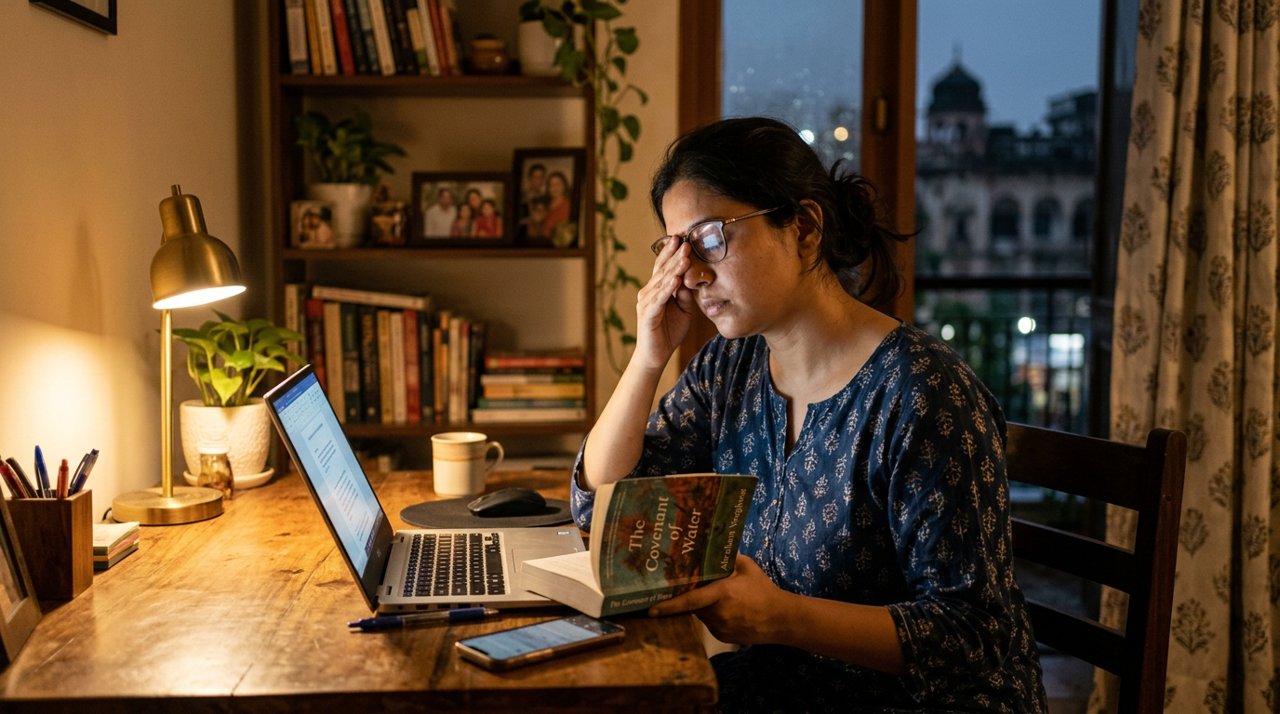
One common reason is hyperopia, also called far-sightedness or plus power. Your eyes can still see far objects clearly, but they have to work extra hard to focus up close, which causes tired eyes, headaches and blurry print by the end of the day. A proper eye test can find it in minutes, and the right plus-power glasses usually make reading comfortable again.
What hyperopia actually is
In a far-sighted eye, light focuses slightly behind the retina instead of exactly on it, usually because the eyeball is a little short. Young eyes can make up for this by using their focusing muscle, so vision may look normal on a basic reading chart. The cost is effort: that muscle never fully relaxes, and close work makes it work even harder. This is why hyperopia is often missed for years.
Signs most people miss
- Eyes feel heavy, sore or burning after reading, studying or phone use
- Headache around the forehead or eyebrows, often in the evening
- Print blurs or "swims" after some time, even though it was clear at first
- Losing your place while reading, or avoiding books and homework
- Squinting or rubbing eyes during close work
- Feeling tired after driving at night or long screen sessions
- In children: a turning-in eye (squint), poor attention in class, or dislike of reading
Hyperopia vs presbyopia vs myopia
These three get mixed up a lot.
- Myopia (minus power): near is clear, far is blurry.
- Hyperopia (plus power): far may be clear, near takes extra effort; strong hyperopia blurs both.
- Presbyopia: the age-related loss of near focus that starts around 40 for everyone. It is not the same as hyperopia, but a person with hyperopia often notices reading trouble earlier, sometimes in their mid-30s.
Why children's hyperopia needs attention
Most babies are slightly far-sighted and grow out of it. But moderate or high hyperopia in a child can lead to eye strain, a squint, or a lazy eye (amblyopia) if one eye is much more far-sighted than the other. Children rarely complain; they just avoid reading. A child-friendly eye test before school age, and again if a teacher notices problems, is worth it. For children, eye drops that relax focusing are sometimes used by eye doctors to measure hidden hyperopia accurately.
How it is checked
- Vision check for distance and near.
- Refraction: the optometrist measures your exact power with lenses and an auto-refractor.
- Checking eye coordination and focusing, especially if you have headaches.
- Guidance to a trusted eye specialist when needed, for example for a child with a squint.
How it is corrected
- Glasses with plus (convex) lenses are the simplest and most common fix.
- Some people need them only for reading and screen work; others need them full-time.
- Contact lenses are an option for adults.
- Laser surgery can treat some hyperopia in adults, after a detailed check by an eye surgeon.
Glasses do not "weaken" the eyes. They simply stop the focusing muscle from overworking.
FAQ
My vision is 6/6. Can I still have hyperopia?
Yes. Young people often pass a distance chart by straining to focus. A full refraction finds the hidden power.
Is hyperopia the same as needing reading glasses after 40?
No. That is presbyopia. But both make near work harder, and many people over 40 have both.
Will hyperopia go away?
Mild hyperopia in young children often reduces as they grow. In adults it usually stays and becomes more noticeable after 40.
Can hyperopia cause headaches?
Yes. Constant focusing effort is a common cause of eye strain and forehead headaches. Headaches can have other causes too, so get checked.
What does plus power mean on my prescription?
A plus sign (+) in front of the sphere number means a converging lens for far-sightedness.
How ORINvue can help
- An eye test by our qualified optometrist, Khushboo Gangwar, free with every package, that checks both distance and near vision
- ORIN Basic glasses at ₹999 all-inclusive, ORIN Smart blue-cut lenses at ₹1,999 for heavy screen users, and Kids Shield at ₹1,499 for children
- Most single-vision glasses ready in 24 hours, free remake within 7 days, and free adjustment and cleaning for life
- Guidance to a trusted eye specialist if a child needs squint or other medical care
Read our guide: https://orinvue.netlify.app/eye-health/hyperopia.html .
ORINvue opens in December 2026 in the Kalyanpur / Vikas Nagar area of Lucknow, open daily from 10 AM to 10 PM.
Information only, not medical advice.
About ORINvue
ORINvue is a new optical store in Lucknow founded by Abhay Kumar, built to make good eye care simple and affordable: honest eye tests, clear prices and glasses made fast. Visit https://orinvue.netlify.app to learn more.
Book a free eye test
More answers: Eye Health Guide by ORINvue · Optical & spectacles Q&A
Related questions
How long does a proper eye test take?
A complete spectacle eye test usually takes about 10 to 15 minutes. It includes a machine reading (auto-refraction), fine-tuning of your power with trial lenses by an optometrist, a near-vision check for people over 40, and a basic check of how your eyes work together. Medical eye examinations by an ophthalmologist with dilation take longer.
How often should I get my eyes tested?
Most adults should have an eye test once a year, or sooner if vision changes. Children are best checked every 6 to 12 months, especially with long study and screen hours. People with diabetes, glaucoma in the family, or anyone over 40 should follow their eye doctor's advice, which is usually a yearly check that includes eye pressure and retina examination.
Is a computer eye test enough?
No. An auto-refractor only gives a starting estimate of your power. A qualified optometrist then confirms the final prescription with subjective refraction, asking you to compare lenses. Glasses made only from a machine reading can feel uncomfortable or cause headaches. At ORINvue, every eye test is done by our qualified optometrist, Khushboo Gangwar, not just a machine.
At what age should a child have the first eye test?
A child's eyes should be checked in infancy if parents notice anything unusual, and every child should have a full eye check around age 3 to 5, before starting school. Early tests catch lazy eye, squint and high power while treatment works best. After that, a check every 6 to 12 months is sensible during school years.
What do minus and plus power mean?
Minus (−) power corrects myopia (short-sightedness), where distant objects look blurred. Plus (+) power corrects hyperopia (long-sightedness) or is used for reading after 40. The number shows the strength in dioptres: −0.50 is mild and −6.00 is high. Your optometrist confirms the exact power during an eye test.
Ask ORINvue a question
Eyes, glasses, lenses ya kids eye care se juda koi bhi sawaal likhiye. ORINvue roz reader questions ka jawaab yahin publish karta hai.